

Where Can Fresno CA Businesses Find Voice-to-Voice Chatbot Development Experts?
Fresno and Central Valley businesses can find specialized voice-to-voice chatbot development experts at local digital agencies like CS Designs and Marketing. This guide covers vendor selection criteria, technical requirements, and integration strategies to help you choose the right partner for measurable ROI. For additional details, review the csdesigns net.
Vendor Selection Criteria
Selecting the right development partner requires looking beyond basic feature lists. You need a team that understands the specific operational workflows of Central Valley small businesses. The following criteria are essential for evaluating potential vendors. For additional details, review the Customer Experience.
Local Expertise and Industry Knowledge
A local agency understands the nuances of the Fresno market. They know the customer demographics, local competitors, and regional business challenges. This context allows them to build chatbots that speak to your specific audience rather than using generic corporate language. Local expertise ensures the bot handles local queries, such as service area questions or regional promotions, with accuracy. For additional details, review the Frequently Asked Questions.
Technical Proficiency in Voice AI
Voice-to-voice chatbot development is distinct from text-based chat. It requires proficiency in Natural Language Processing (NLP) and speech recognition technologies. The vendor must demonstrate experience with low-latency voice responses. High latency breaks the conversational flow and frustrates users. Look for a team that has deployed voice interfaces in real-world business settings, not just theoretical prototypes. For additional details, review the About.
Integration Capabilities
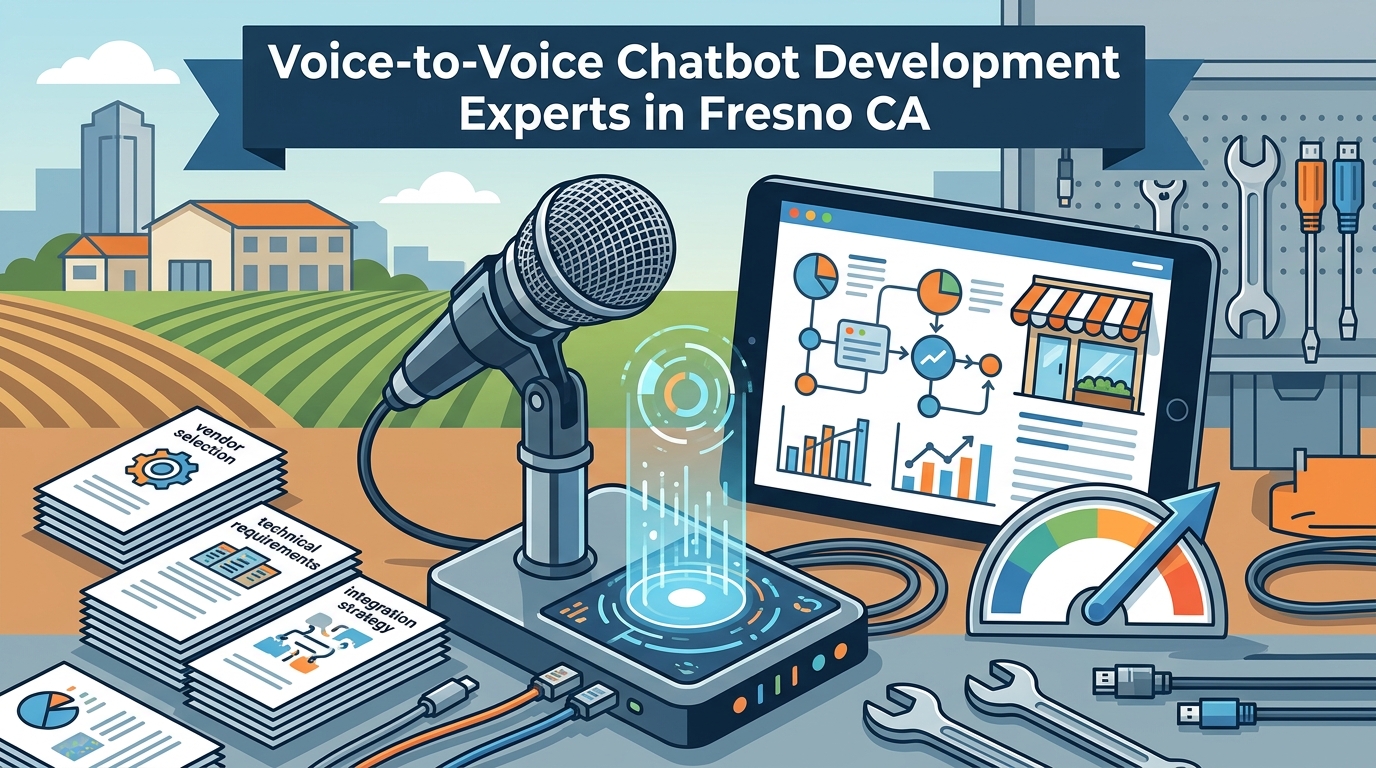
Technical Architecture and Integration
Understanding the underlying technology helps you ask the right questions during vendor evaluations. Voice-to-voice chatbot development is the process of creating an AI system that listens to human speech, processes the intent, and responds with synthesized human-like audio. This architecture typically involves three core components.
Speech Recognition and NLP
The first component is the speech-to-text engine. It converts audio input into text. The second is the NLP engine, which interprets the meaning and intent behind the words. These two components work together to understand user queries. Accuracy in this stage is paramount. Misinterpretations lead to incorrect responses and poor user experiences.
Response Generation and Synthesis
Once the intent is understood, the system generates a response. This can be a pre-scripted answer or a dynamic response generated by a large language model. The text response is then converted back into speech using text-to-speech synthesis. The quality of the synthesized voice matters. It should sound natural and professional. Robotic or unclear voices reduce user trust and engagement.
Backend Integration and Data Flow
The final component is the integration layer. This connects the AI logic to your business data. It allows the bot to look up appointment availability, check inventory, or retrieve customer records. This layer ensures the bot provides accurate, real-time information. It also logs interactions for future analysis and improvement. A robust architecture ensures that data flows securely and efficiently between the voice interface and your core business systems.
Measuring ROI and Performance
Investing in voice-to-voice chatbot development is a business decision. It must deliver measurable returns. You need to track specific metrics to evaluate performance. These metrics help you determine if the investment is paying off and where to make improvements.
Cost Savings and Efficiency
One of the primary benefits is reduced labor costs. The bot handles routine inquiries, freeing up human staff for complex tasks. Track the number of interactions handled by the bot versus humans. Calculate the cost per interaction for both. This comparison reveals the direct financial savings. It also highlights the efficiency gains in your customer service operations.
Customer Satisfaction and Engagement
Financial metrics are important, but customer experience is equally critical. Measure customer satisfaction scores for bot interactions. Track the resolution rate, which is the percentage of queries fully resolved by the bot. High resolution rates indicate a well-designed system. Low rates suggest gaps in the bot's knowledge base or logic. Monitor these metrics over time to identify trends and areas for improvement.
Conversion and Revenue Impact
For sales-focused bots, track conversion rates. Measure how many bot interactions lead to a sale, appointment, or lead capture. Compare this to conversion rates from other channels. This data shows the direct revenue impact of the voice interface. It helps you justify the ongoing maintenance and development costs. A clear link between bot performance and revenue growth is the strongest argument for continued investment.
Local Market Fit in the Central Valley
The Central Valley has a unique business landscape. It is a mix of agricultural, service, and retail sectors. Each sector has specific needs for customer communication. A local agency like CS Designs and Marketing understands these nuances. They can tailor the chatbot to fit your specific industry and customer base.
Industry-Specific Solutions
Different industries require different bot capabilities. A healthcare provider needs a bot that can handle appointment scheduling and insurance questions. A retail store needs a bot that can check inventory and process returns. A local agency can build industry-specific modules. These modules ensure the bot addresses the most common queries in your sector. This specialization improves accuracy and user satisfaction.
Regional Customer Preferences
Support and Maintenance
Local proximity matters for ongoing support. If the bot encounters an issue, you need a team that can respond quickly. A local agency can provide on-site support if needed. They can also conduct in-person training for your staff. This hands-on approach ensures your team is comfortable using and managing the system. It also allows for faster iteration and improvement based on real-world feedback.
Key Takeaways
- Local expertise is critical for building chatbots that resonate with Central Valley customers.
- Voice-to-voice chatbot development requires proficiency in NLP, speech recognition, and synthesis.
- Seamless integration with existing CRM and scheduling systems is essential for operational efficiency.
- Measure ROI through cost savings, customer satisfaction, and conversion rates.
- Industry-specific modules improve accuracy and address common sector-specific queries.
- A natural, professional voice quality is vital for building user trust.
- Continuous monitoring and iteration are necessary to maintain high performance.
Frequently Asked Questions
What is the difference between a text chatbot and a voice-to-voice chatbot?
A text chatbot processes written input and outputs written responses. A voice-to-voice chatbot processes audio input and outputs synthesized audio responses. The voice version requires additional components for speech recognition and synthesis, making it more complex to develop.
How long does it take to develop a voice-to-voice chatbot?
Development time varies based on complexity. A basic bot with pre-scripted responses can take a few weeks. A sophisticated bot with dynamic responses and deep system integrations may take several months. A local agency can provide a detailed timeline based on your specific requirements.
Can a voice chatbot integrate with my existing website?
Yes, most voice chatbots can be embedded into websites using JavaScript widgets. They can also be accessed via phone numbers or dedicated apps. Integration with your website ensures customers can interact with the bot directly from your online presence.
What kind of data does a voice chatbot collect?
Voice chatbots collect audio data, transcribed text, and interaction logs. This data is used to improve the bot's accuracy and to analyze customer behavior. It is important to ensure that data collection complies with privacy regulations and that customers are informed about data usage.
How do I measure the success of my voice chatbot?
Success is measured through metrics like resolution rate, customer satisfaction scores, and cost per interaction. You should also track conversion rates if the bot is used for sales or lead generation. Regular reporting on these metrics helps you evaluate performance and make improvements.